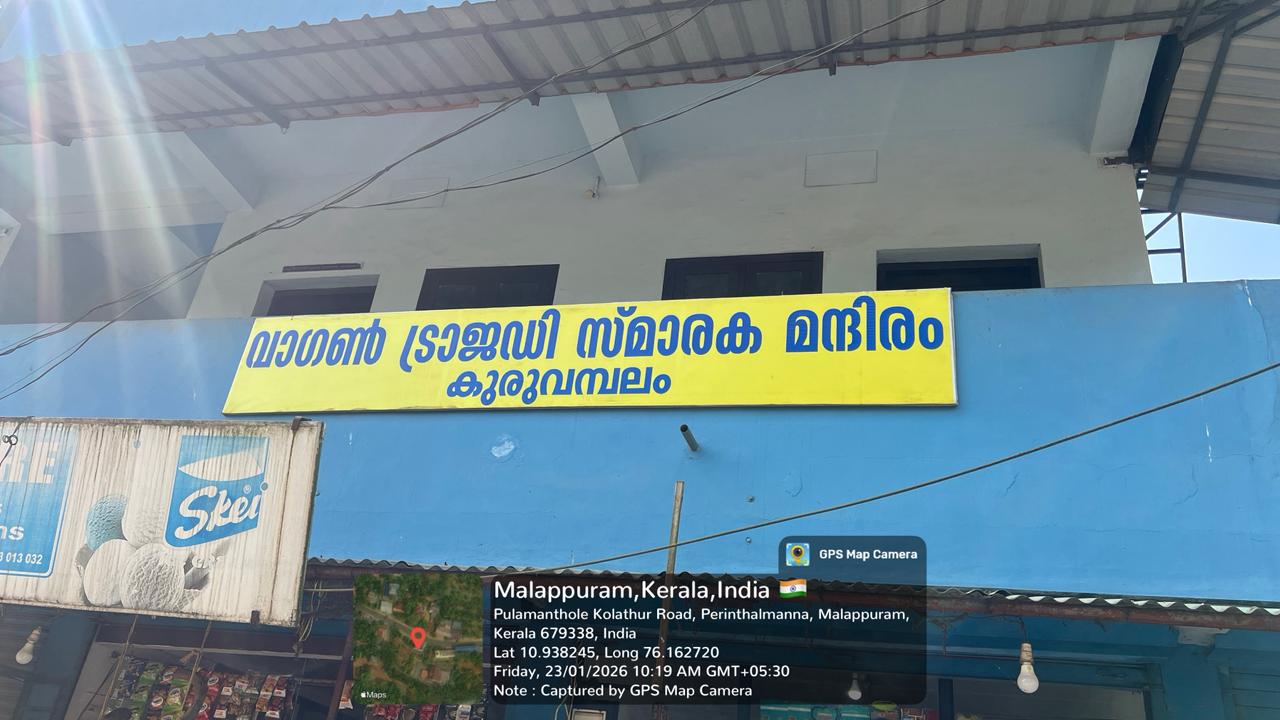
Wagon Tragedy Smaraka Mandiram
Wagon Tragedy of 1921, Of the seventy people who died in the forty-one were from the areas of Kuruvambalam, Valapuram, and Chemmalassery in Pulamanthole Panchayat. The Indian freedom struggle was a great movement that reshaped Indian history and became deeply rooted in the social and cultural spheres of the country. Compared to neighboring panchayats, Pulamanthole played a significant role in this movement. Many people from this area participated in the Congress conference held at Ottapalam under the leadership of Annie Besant. Prominent among them were Pokker Haji, Moythukutty Haji, and Marakkar Haji.
By the beginning of 1921, Khilafat Committees had already started functioning in the region. K.P. Pokker Haji served as the secretary of the committee. During the uprising, the Kandappathu Bridge at Kattuppara was demolished, and the ferry raft on the Pulamanthole River was destroyed.
Subsequently, British authorities shot and killed Pattukuthu Moytheen Kurikkal, Kanakkavanthodi Alavi, Pallithodi Unnippa, Parappulayan Moytheenkutty, and Bapputty (known as Mammu of Njeliyathodi) at Kattuppara. They also shot and killed Kolliyath Mammad and Kanjirakkadavath Kunjunyen in the Pulamanthole area.
Invoking the Arms Act, the British authorities burned down numerous houses in Kattuppara during that period. Another notable aspect of the rebellion was that the Mappila Muslims provided protection to all Hindu landlord families who neither acted as British agents nor displayed caste-based domination or hostility toward tenants. It is said that Mappila youth even traveled from Kattuppara to protect Elamkulam Mana, the ancestral home of E.M.S. Namboodiripad.
In the early 1930s, a large public meeting was held on the banks of the Pulamanthole River, attended by leaders such as K. Kelappan, M. Karthyayani Amma, and Muhammad Shafi. Another important development during this period was the emergence of the Youth Association. Under its leadership, a public library was established, making newspapers such as Mathrubhumi, Al-Ameen, and Prabhatam, along with many books, available to the public.As a result of the association’s efforts, the first Upper Primary School (Higher Elementary School) in the panchayat began functioning. Madavattath Muhammad Haji was its first student.
In 1933, following a conference held under the leadership of Kattilassery, efforts began to establish the first madrasa in Pulamanthole.
In 1936, a reception was organized for M.P. Narayana Menon after his release from prison.